- Sustainability
- Posts
- 🏗️ Nitrogenation for sustainable concrete, Bio-inspired lithium extraction, and World’s longest plane for turbine blades
🏗️ Nitrogenation for sustainable concrete, Bio-inspired lithium extraction, and World’s longest plane for turbine blades
🌍 Step into the eco-sphere with IE for the 7th issue of Sustainability

 | In Coordination with IE AcademySubscribe now to get notified every time IE Academy releases the latest courses in engineering.From artificial intelligence to electrical engineering, you can get workshops from experts and have access to live classes with real-time interaction. |
Welcome back to the seventh edition of Sustainability, a weekly newsletter by Interesting Engineering.
Last week witnessed many lithium-related sustainable developments including American scientists devising a more eco-friendly way to source lithium to meet the soaring energy demands. They demonstrated an approach to enhance the efficiency and selectivity of lithium extraction through differences in kinetic and chemo-mechanical barriers. Their findings revealed that medium-sized particles offered the best balance of properties, leading to the highest lithium selectivity.
This week, researchers from the University of Birmingham in a new Nature study claim that concrete nitrogenation could reduce nitrogen oxide (NOx) emissions by 3.4 to 6.9 megatonnes (Mt), representing six to 13 percent of industry-related emissions in 2021. The cumulative economic potential is projected to exceed $150–160 trillion, accompanied by a NOx mitigation of 131–384 million tons between 2021 and 2050, equivalent to 75–260 years potentially lost to premature death and reduced quality of life (measured in disability-adjusted life years).
Additionally, scientists from the Qingdao Institute of Bioenergy and Bioprocess Technology (QIBEBT) of the Chinese Academy of Sciences, developed an eco-friendly, durable method for lithium extraction by devising a crystalline carbon nitride membrane that mimics biological ion channels. They introduced a “congener-welded” crystalline carbon nitride membrane with bio-inspired enhancements that significantly outperform traditional polymer membranes. In other news, a Colarodo-based energy startup, Radia adopted an unconventional approach to solve the issues faced with transporting massive turbine blades. Instead of trying to generate renewable energy by building wind farms, the firm developed WindRunner – the world’s largest aircraft that could ship turbine blades at costs comparable to road transport.
With rapid urbanization and robust growth in the cement industry, authorities worldwide are encouraging sustainable solutions in construction. Firms like Sublime Systems are decarbonizing cement production with an electrochemical process, while Thyssenkrupp Decarbon Technologies plans to use "pure oxyfuel" technology for carbon-neutral cement plants.
With that, I, Shubhangi Dua, your author for Sustainability, welcome you to the seventh edition.
IE+ SUPPORT INTERESTING ENGINEERING
Invest In Science And Engineering
Subscribe to IE+: Join us as we delve into exclusive weekly content on sustainable technology. You now have the opportunity to join our eco-conscious community, gaining access to top stories on sustainability in STEM, along with recommendations and tips to embark on your own sustainable journey—all ad-free.
NEWS
⚙️ Bio-inspired membrane to transform lithium extraction from salt lakes The method could pave the way for a more viable longer-lasting solution for lithium extraction.
🐄 Cows that eliminate 85% of body heat may boost food security in warming world Climate change is making it more difficult to raise cattle as growth and reproduction are affected by heat.
✈️ World’s longest plane plans to fly football-field long wind turbine blades The Wind Runner can transport a 345-foot-long blade or even three 280-foot-long blades in one go.
🏗️ Construction equipment is going electric. Here’s what it’s like behind the wheel I tested a 55,000-pound electric excavator. New ways to power off-road machines, which mostly run on diesel, could cut about 3 percent of U.S. carbon emissions.
🌎 World falling behind on environment, health and hunger goals, UN report says The world is way off track on most of the sustainable development targets agreed in 2015, such as tackling poverty and hunger, says a United Nations report.
MUST READ
In an ambition to meet the net-zero targets, governments around the globe have been promoting green policies that encourage civil engineers to execute construction projects while keeping emissions in check.
The process of nitrogenation was particularly spotlighted, it means adding nitrogen to concrete which can make the cement more sustainable. This process involves incorporating nitrogen compounds into the concrete mix, which then react to capture and neutralize pollutants like NOx. As a result, the air pollution is reduced, showing that the material is more environmentally friendly.
Since rapid urbanization has increased the demand for concrete, leading to elevated resource consumption and waste, such sustainable solutions have become imperative. Traditional methods like carbonation (adding CO2 to concrete) have shown potential for reducing emissions, and recent experiments on nitrogenation have documented additional environmental benefits.
Researchers deduced that nitrogenation could reduce NOx emissions by 3.4 to 6.9 million tons, which could be economically beneficial as well. They claim that this reduction could result in economic benefits exceeding $150–160 trillion between 2021 and 2050, along with significant health benefits. The study says that NOx mitigation in this case is equivalent to 75–260 years potentially lost to premature death and reduced quality of life (estimated in terms of disability-adjusted life years). DALYs measures the overall burden of disease by accounting for years of life lost and years lived with disability.
The study compared nitrogenation with carbonation, noting that both processes rely on the availability of reactive alkaline components in concrete. However, nitrogenation might offer greater economic and environmental benefits in many regions. Despite the promising results, the research acknowledges uncertainties and the need for further studies to confirm the best approaches for sustainable concrete production.
Co-author Dr. Yuli Shan, from the University of Birmingham in a statement by the university noted that cities around the world, particularly those in the global south, are experiencing extensive urban renewal, expansion, and modernization – all inevitably creating atmospheric pollution.
“Between 1970 and 2018, global NOx emissions nearly doubled from 70 Mt to 120 Mt. Addressing and managing these emissions is crucial for enhancing urban health, fostering sustainable industrial growth, and ensuring environmental well-being.”
OTHER IMPORTANT UPDATES
💨 Wind turbine blades could be turned into giant batteries, says Swedish firm
♨️ Industrial revolution?: Swiss heat pump hits 392°F, cuts costs, emissions
🌅 Equinor, GRTgaz sign deal for CO2 transport system to Norway
🔥 US braces for ‘dangerous’ conditions as heatwave to hit midwest and north-east
🪨 MIT spin-off plans to extract 10x more energy from 700°F superhot rocks
☢️ Bill Gates begins building 345-megawatt Natrium nuclear reactor in US
👩🏽⚖️ Making climate models relevant for local decision-makers
⚙️ Act to shrink your carbon footprint
Credit: Bilanol / iStock
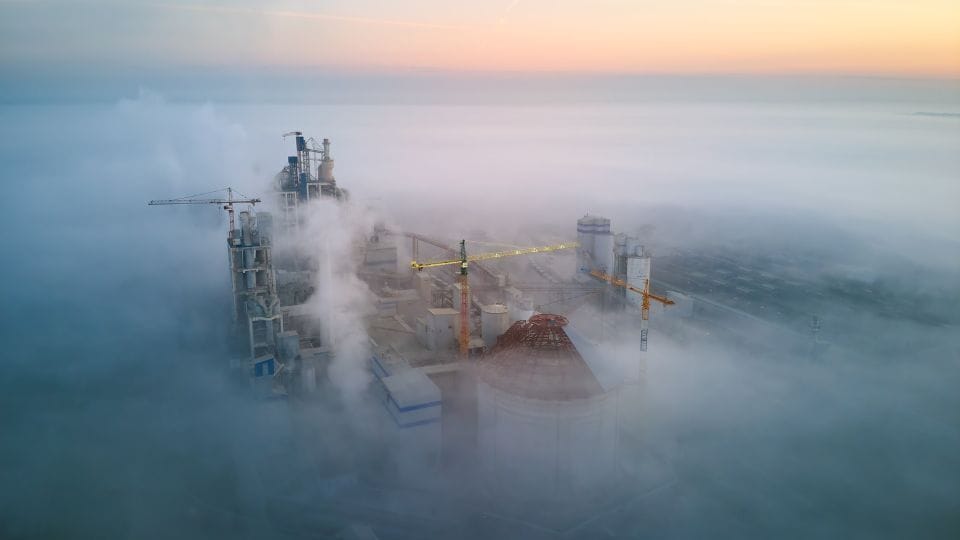
With rapid urbanization and robust growth in the cement industry, authorities worldwide are encouraging sustainable solutions in construction. Here are some firms working towards these solutions to meet net-zero targets and aid in the fight against climate change.
Sublime Systems
Leah Ellis, the co-founder and CEO of Sublime Systems explained to IE in a podcast that the firm’s cement technology aims to decarbonize cement production which is a major source of CO2 emissions. Sublime uses an electrochemical process to devise cement at ambient temperature using electricity, making it both efficient and environmentally friendly. She emphasized that it's a true zero technology, not net zero implying that the process makes the same concrete but without emissions. Recently, the company’s cement will be featured in One Boston Wharf Road’s primary public space, called the Paseo. The building has been claimed to be the largest net-zero-carbon office building ever built in Boston.
Thyssenkrupp Decarbon Technologies
Earlier in April, Thyssenkrupp Decarbon Technologies inaugurated the construction of the world’s first carbon-neutral cement plants. They developed a “pure oxyfuel” technology to transform sustainable cement production, IE reported. As per the study, every year, cement and concrete production generates as much as nine percent of all human CO2 emissions worldwide. Thus, this technology will aim to combat the challenges by deploying ‘pure oxygen’ in the combustion process, replacing ambient air. The firm said that the technology would facilitate the capture of almost 100 percent of carbon emissions from cement clinker production.
Eco Material Technologies
The firm developed a green cement called PozzoSlag that reengineers pozzolanic cement to react faster, achieving the same performance as traditional portland cement within one day. It has been claimed to be 20 percent stronger than portland cement after 28 days and continues to gain strength over the long term. Importantly, PozzoSlag can be manufactured at room temperature with minimal emissions, making it nearly carbon-neutral.
Heidelberg Materials
The German-based firm developed a range of low-carbon concrete called EcoCrete with an ambition to make sustainable concretes easily accessible. Heidelberg says that EcoCrete reduces the CO2 emissions associated with standard CEM I concrete by up to 85 percent, helping contractors and clients meet their carbon reduction targets. Heidelberg Materials' green cement technology uses Regen GGBS (ground granulated blast-furnace slag), a by-product of iron-making, to replace some of the cement in concrete. This reduces the embodied CO2 by approximately 780kg for every tonne of Portland cement (PC) replaced. Additionally, GGBS enhances the long-term durability of structures, conserves natural resources by eliminating the need for quarrying, and prevents the slag from being disposed of in landfills.
UK Hempcrete
The firm based in Chesterfield is currently leading the market with its hempcrete also called ‘hemp-lime’ – a type of sustainable low- or zero-carbon construction material made from the inner woody core of the hemp plant mixed with a lime binder. This material is used for both new builds and retrofits, particularly for upgrading and repairing traditional and historic buildings. It’s especially great for those trying to preserve old architectural structures. The firm says, that hempcrete provides excellent insulation, which improves the energy efficiency of buildings while also enhancing its durability. Using hemp, a fast-growing plant, conserves natural resources compared to traditional building materials.
More to come in the forthcoming edition of Sustainability.
 | Written by Shubhangi Dua Sustainability Journalist
|

Additional Reads
🚨 The Blueprint: IE's daily engineering, science & tech bulletin.
⚙️ Mechanical:Explore the wonders of mechanical engineering.
🧑🏻🔧 Engineer Pros: The latest in engineering news, career updates, and insider knowledge.
🧠 AI Logs: Insights into the intricacies and developments within the realm of artificial intelligence.
🎬 IE Originals:Weekly round-up of our best science, tech & engineering videos.
🛩️ Aerospace: The latest on propulsion, satellites, aeronautics, and more
⚡Electrical: From AI to smart grids, our newsletter energizes you on emerging tech.
🎓 IE Academy: Master your field and take your career to the next level with IE Academy
Want to share your feedback? [email protected]


